Polling Places on Reservations Would Protect Native’s Right to Vote

photo (9)None of us can afford to take the right to vote for granted – as Native Americans living on reservations in Montana can confirm. On the Fort Belknap, Northern Cheyenne, and Crow reservations, Native Americans who want to vote, or even register to vote, have to travel as much as 180 miles over rough, rural roads to reach county election offices.

The distance and the expense are serious barriers to accessing the ballot box.

Mark Wandering Medicine, a Northern Cheyenne, has filed a lawsuit in Montana calling for satellite voting offices on reservations, a step that will remove the hardship and the barriers that Native Americans face trying vote.

The Northern Cheyenne Tribe reservation in southeastern Montana is one of the most isolated. Traveling to Forsyth, the county seat, means having a vehicle, affording gas, then hours on rugged roads.

“We have a tough time of it really, most people just don’t have the means of going all the way over there,” he said. “It is a real hardship to go, and once we arrive there, we are not treated well. We run into a lot of discrimination.Continue reading “Polling Places on Reservations Would Protect Native’s Right to Vote”
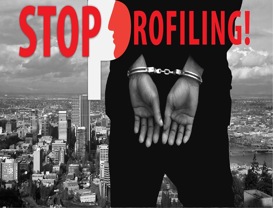
Speaking Up, Sharing Stories to Stop Police Misconduct

Stop profiling picLisa Haynes was waiting for a bus near her home in Portland, Ore., when two police officers passing in a patrol car stopped and began questioning her. Uncertain of what was happening, or why she was being questioned, she turned to walk away. Within moments, Haynes, 4’10”, was forcefully grabbed, pushed to the ground and was handcuffed. One of the officers had his knee in her back as he cursed at her. She was arrested and shoved inside the patrol car.

Police later said they had mistaken the petite, 40-something African American woman, for a 5’6” male, Hispanic suspect they had been pursuing.  They released the handcuffs and told her to go home.

“All along I had been asking the officers why this was happening to me,” said Haynes. “Alas, I knew the answer: it was because I am black.  No other reason. They treated me like this – violated me like this – because I’m black.”
Continue reading “Speaking Up, Sharing Stories to Stop Police Misconduct”

Student Debt Threatens the Future for Everyone

overwhelmed_student-300x300A college degree was once an investment in the future, a path to a good job, a home, car, vacation and money set aside to retire some day. But that college education has for many, become a ball and chain limiting future growth. Unless we begin to address this debt issue we will continue to see a growing chasm in American society – those who have access and wealth –  and those who have mortgaged their future with little way to dig themselves out of debt.

Since the Great Recession began, states have dramatically cut their allocations for higher education. Nationwide, higher education budgets have been slashed 27 percent since 2008 or more than $2,300 per student.  We are just now beginning to see the effects on our economy – and the great risk to our future.
Continue reading “Student Debt Threatens the Future for Everyone”

The Penalty for Being Poor – Prison

By Simmi Bagri
Alliance for a Just Society

Imagine being poor. Then imagine that the depth of your poverty is compounded because you committed a minor infraction. You can’t pay your ticket. You go to court and are put under a probation monitoring service – more fees and fines. You can’t afford bus fare, so you walk everywhere. You can’t afford food, so you go hungry.

Then imagine being put in jail because you can’t pay the fines. Your life has been criminalized, and infrastructure that ought to allow you to you to make amends and move forward, traps you. You can’t escape it. Now you can stop imagining, because that is exactly what is happening across the United States today

Earlier this month the Human Rights Watch released a report titled “Profiting From Probation: America’s Offender-Funded Probation Industry,” which describes a probation model that incentivizes private for-profit companies to prey on low-income misdemeanor offenders.
Continue reading “The Penalty for Being Poor – Prison”

The Fight for Citizenship and the Right to a Future

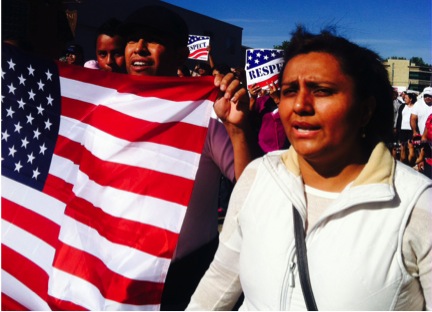
The fight for fair and humane immigration reform is about respecting the dignity and humanity of all immigrants across the U.S. It is a fight for family unity. But this fight is also about the evolving definition of citizenship.

CitizenshipCitizenship is a guarantee against deportation; a protection against fear and reprisals. Any immigrant, regardless of status, can be deported – whether they are undocumented, a permanent resident with children who are U.S. citizens, or married to a U.S. citizen. Even a minor mistake on your application for citizenship can jeopardize your status in the country and launch you into deportation proceedings.

Providing a meaningful pathway to citizenship means guaranteeing a predictable route – and a future – for those who want to become citizens. To have citizenship in the U.S. means that you get to be a full human – with full rights. Being a citizen means that you can vote.

So let’s be blunt, voting is the real problem.
Continue reading “The Fight for Citizenship and the Right to a Future”

Apply Now: Summer 2014 Public Policy Internships

We are now accepting applications for Alliance summer and fall Public Policy Internships.

An internship with the Alliance is an opportunity to work on social justice issues like income inequality, health care access, and immigration that impact millions. Interns will have the opportunity to work on important, tangible public policy products with immediate impacts.

Continue reading “Apply Now: Summer 2014 Public Policy Internships”

Driver’s Licenses for Immigrants Strengthens Families and the Economy

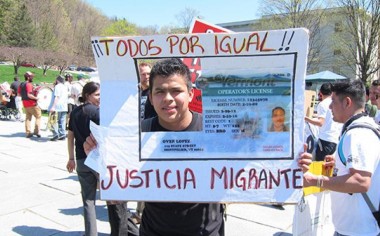
Across the nation, families, business owners, and police officers are calling on lawmakers to bring fairness to all in need of driver’s licenses – an item that many simply take for granted as an award for learning the rules of the road.

Drivers license copyBut for millions of undocumented residents throughout the U.S., the denial of this basic driving privilege has stifled their way of life.

Regardless of citizenship status, all can agree that daily activities require driving. Basic tasks like getting to and from medical care facilities, taking or picking up children from school, participating in family curricular activities, and traveling to and from work, unduly burdens the unlicensed. It also strains states’ limited financial resources.

Denying driver’s licenses to undocumented residents is a law that creates more harm than good and it needs to be changed.
Continue reading “Driver’s Licenses for Immigrants Strengthens Families and the Economy”

Tipping Subminimum Wage in Favor of Workers

When you go out to dinner at a restaurant you might ask for salad dressing on the side, whether the carrots are organic, or if the chicken is free range, but do you ever ask the restaurant owner if her employees make a living wage?

Waitresses and waiters are the largest group of tipped workers in the United States; they also struggle with a significantly higher rate of poverty than the rest of the workforce. Tipped workers are also more likely to be women and people of color, contributing to the broader race and gender wage gaps.Tips

While the federal minimum wage is $7.25 cents per hour, the tipped minimum wage has been frozen at just $2.13 per hour for the last 23 years. Seven states don’t have a separate tipped minimum wage, and some have higher tipped wages than the federal figure, however, tipped workers in most states rely on tips from customers to round out the rest of their salary.

When the economy is slow or when weather keeps customers at home, tipped workers see their hours cut and tips shrink, causing many to turn to public support just to stay afloat. Food servers collect food stamps at twice the rate of the U.S. workforce as a whole, and are three times more likely to live below the poverty line. Continue reading “Tipping Subminimum Wage in Favor of Workers”

Beyond Cellblocks: Reducing Criminalization, Promoting Health Care Access & Racial Justice

This is the first in a series of webinars on ending criminalization of everyday life that will be offered by the Alliance for a Just Society. The Alliance is a national research, policy and organizing network focused on social justice, including ending racial disparity and promoting health equity.

Like many other cities, Seattle has long struggled to address public safety concerns raised by low-level public drug sales, drug use, and prostitution. LEAD was created after Seattle elected officials, public defenders, and community and business groups collectively reached a point of exhaustion, recognizing that status quo of drug law enforcement was failing.

This webinar discusses the origins of LEAD, how it operates, how and when it will be formally evaluated, and prospects for replication in other communities. You can watch both halves in the player below.

RELATED READING: Listen to NPR Seattle’s report on the Seattle Police Department’s new policy. Continue reading “Beyond Cellblocks: Reducing Criminalization, Promoting Health Care Access & Racial Justice”

Expanding Health Care Coverage With Federal Funds In Idaho Will Create Economy-Boosting Jobs

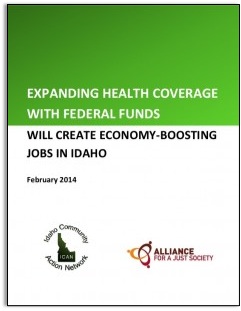
Medicaid report jobsIf Idaho accepts federal funds to expand Medicaid coverage, an estimated 88,000 state residents will gain health insurance.  In addition, accepting the federal funding will also create jobs  more than 16,000 jobs and boost the Idaho economy, according to a new report by the Alliance for a Just Society. The report was released today by Idaho Community Action Network.

According to an analysis by University of Idaho economist Steven Peterson, if Idaho adopts the health coverage expansion in 2014, the new spending on health care services and its ripple effects will create 16,337 jobs in the state and increase total compensation by $567 million (in constant 2012 dollars) in 2024. The majority of jobs will be in the health care fields, but others will be created in food and lodging, social services, business services, transportation and construction.
Continue reading “Expanding Health Care Coverage With Federal Funds In Idaho Will Create Economy-Boosting Jobs”